Executive Summary: In modern petrochemical and manufacturing plants, extreme background noise renders traditional leak detection methods ineffective. Invisible gas leaks not only waste massive energy but also pose severe safety risks. This guide decodes the core physics behind HertzInno's acoustic cameras. Learn how we leverage the 20-40kHz ultrasonic "sweet spot" and the powerful spatial gain of a 144-microphone array to isolate microscopic leaks from deafening noise.
Case Details
How to Pinpoint Tiny Gas Leaks in Extremely Noisy Factory Environments?
—— Decoding the Anti-Interference Logic Behind Hertzinno's Acoustic Imaging Technology
Introduction: The "Deafening" Challenge of Industrial Leak Detection
Walk into any modern manufacturing plant, petrochemical facility, or refinery, and you will be greeted by an invisible "wall of sound." Between the roaring of compressors and the severe vibration of heavy pipelines, the background noise level on a shop floor can easily exceed extreme limits.
Traditional leak detection methods—such as the soapy water test or close-range gas sniffers—are not only inefficient but often completely impractical within complex pipeline networks. Yet, these tiny, invisible leaks are silent profit killers, draining vast amounts of energy annually and creating severe safety hazards.
So, how does a modern acoustic imaging camera "hear" a microscopic air leak over the deafening roar of industrial machinery? The secret lies in transcending the physical limits of human hearing.
The Science of Sound: Decoding the Acoustic Signature of Gas Leaks
To understand how Hertzinno's technology cuts through the noise, we must first dissect the acoustic nature of a gas leak.
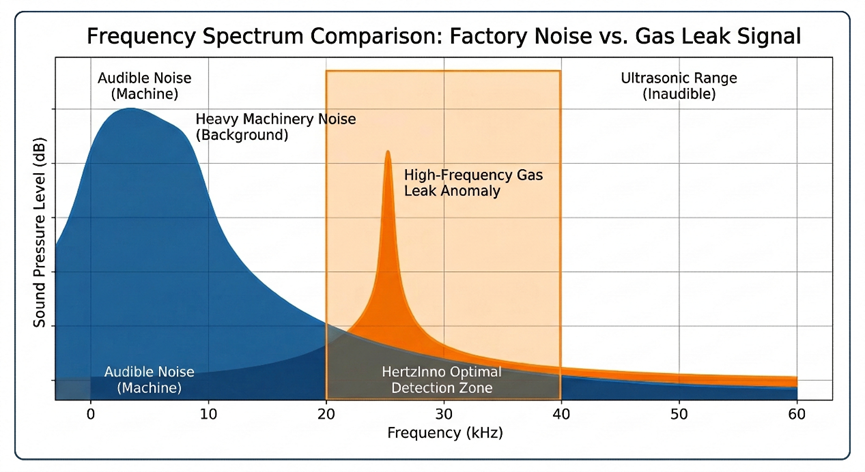
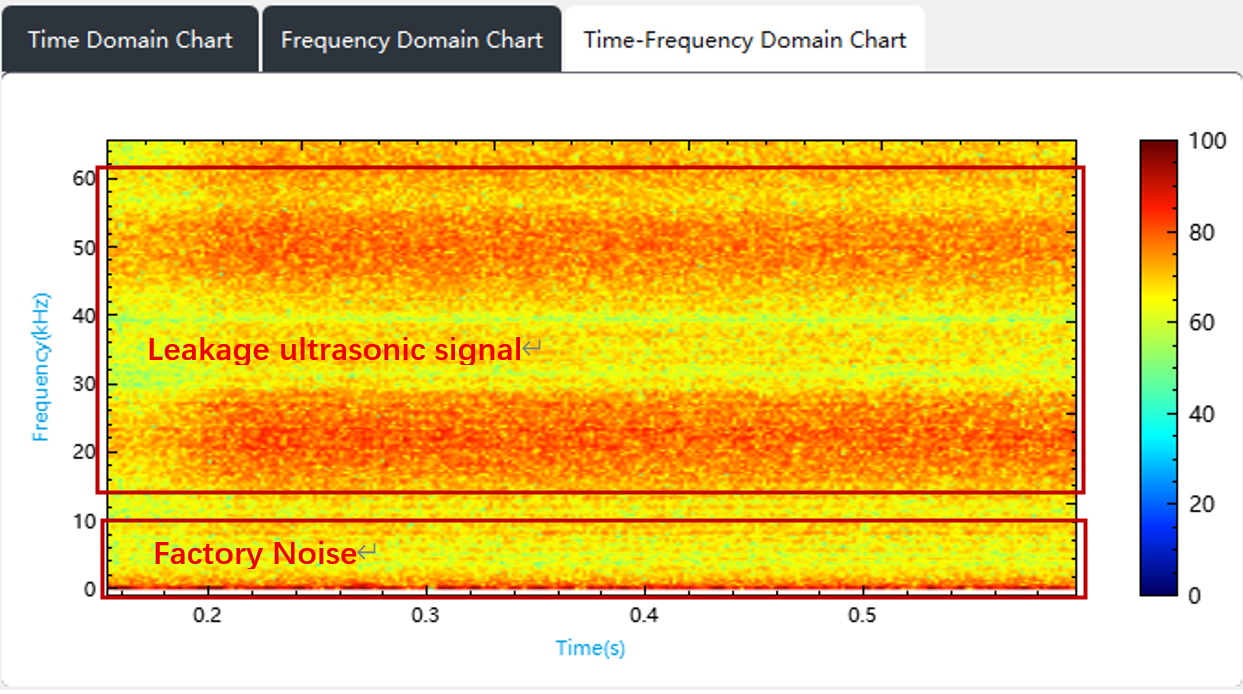
- Locking in on the Frequency "Sweet Spot" The vast majority of industrial background noise (such as motors and gears) has its energy concentrated in the lower frequency bands below 10 kHz. In contrast, when pressurized gas escapes through a tiny orifice, it creates turbulence that manifests as continuous broadband "white noise." The most effective frequency range for detecting ultrasound generated by a compressed air leak or partial discharge is between 20kHz and 40kHz. By specifically tuning our sensors to this 20-40 kHz "sweet spot," the acoustic camera effectively achieves perfect acoustic immunity against low-frequency mechanical noise.
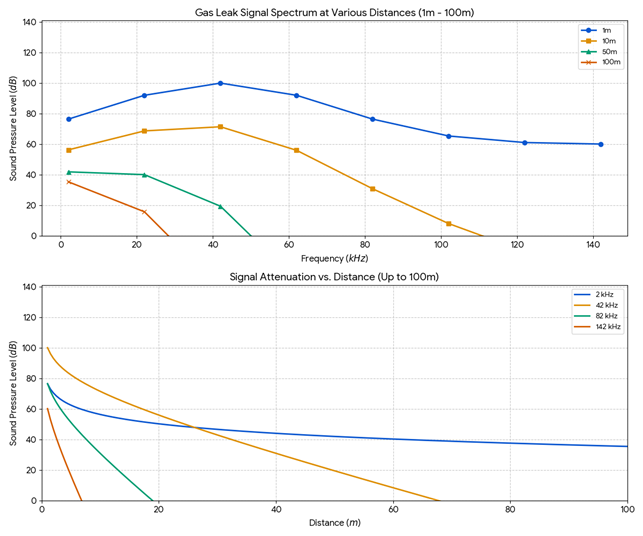
- The Battle Between Distance and Attenuation In real-world applications, high-frequency sound waves are more easily absorbed by the air, limiting their travel distance. HertzInno’s algorithms are designed to adapt to this physical attenuation. To detect leaks over long distances or partial discharge from high voltage equipment outdoors, the camera should be tuned to lower frequencies that travel farther, such as the 10 to 30 kHz range. Conversely, sounds with higher frequencies, reaching up to 65kHz, are best suited for identifying problems that require close-range inspection, such as compressed air, compressed gas, or vacuum leaks.
Breaking the Limits: HertzInno’s Acoustic Array Architecture
Once the target frequency is identified, how do we extract an extremely precise location from a faint high-frequency signal? This brings us to the core hardware: the Microphone Array Design.
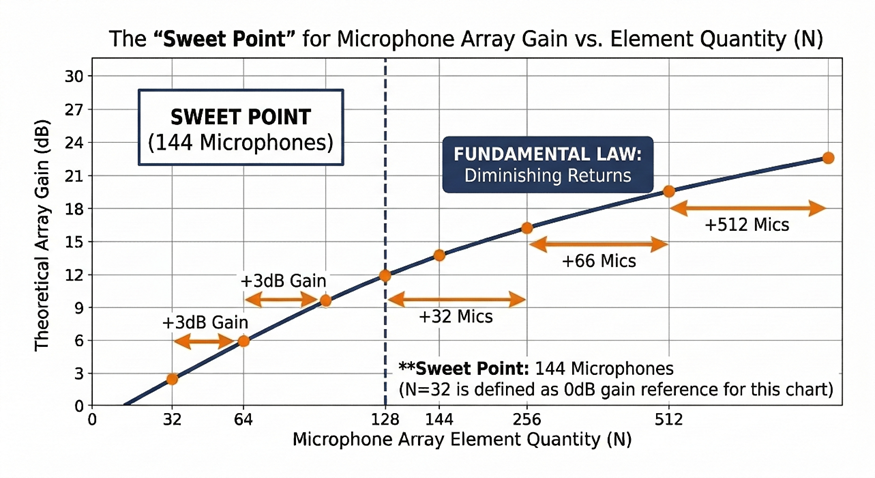
- Microphone Quantity Dictates the SNR Limit A single MEMS microphone inevitably generates self-noise, which severely impacts the measurement accuracy of weak signals. The core logic behind HertzInno's high-density microphone array is simple but powerful: more microphones mean a higher Signal-to-Noise Ratio (SNR). Ideally, doubling the number of array elements increases the array gain by 3 dB. By leveraging massive array computations, we literally "peel" the true leak signal out from the background interference.
- Extreme Lateral Spatial Resolution In dense pipeline areas, multiple interference sources are often clustered together. Lateral spatial resolution, which is the minimum distance between the centres of sound of two sources that can be in a direction perpendicular to the axis of the acoustic imaging equipment, is a critical performance indicator. Thanks to rigorous array spacing optimization (λ/2), HertzInno achieves an exceptionally low lateral spatial resolution. This ensures that even in crowded industrial setups, two closely situated leaks are distinctly separated rather than blurred into a single false hotspot.
Purpose-Built for the Harshest Scenarios
Beyond superior algorithms, predictive maintenance tools must survive the most hazardous industrial environments. For critical sectors like petrochemicals and natural gas, where explosive risks are present, HertzInno has engineered specialized ATEX-certified models.
The industry-leading HA3LX is an ATEX-certified acoustic camera that integrates laser methane sensing, supporting real-time acoustic visualization and methane quantification simultaneously. Meanwhile, the HA3X combines Leak Mode + 640*512 IR + ATEX, providing the ultimate heavy-duty inspection solution for harsh environments.
Case Study: Finland. Hertzinno acoustic imaging technology in action at a major industrial site. Even in complex environments with heavy background noise, the system accurately pinpoints gas leaks in real-time.
Conclusion
In modern industry, pinpointing a gas leak is not just about plugging a hole. By capturing the abnormal surge in ultrasonic energy at the earliest possible stage, facilities can secure the longest possible warning time before a critical failure occurs.
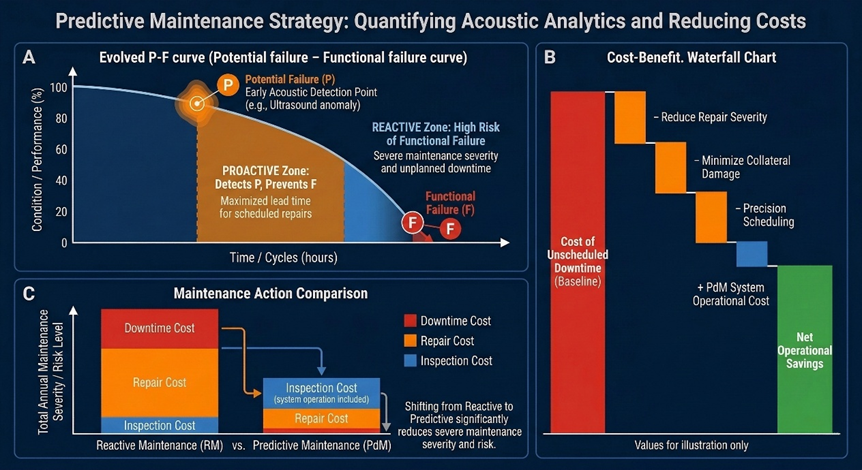
Leveraging the high spatial gain of HertzInno's dense microphone arrays and precision 20-40 kHz filtering, factories can proactively identify risks and recover immense energy losses—even in the most deafening and hazardous ATEX zones. Say goodbye to the era of guessing where leaks are, and let cutting-edge Machine Hearing provide the absolute answer.
Curious to see how the HertzInno HA3-Series performs on your noisy shop floor? Contact our engineering team today to schedule a live demo or download our comprehensive Predictive Maintenance Solution Guide.
Explore Hertzinno Predictive Maintenance Solutions
Curious to see how our technology performs on your noisy shop floor? Discover the right acoustic imaging camera for your facility:
- HA1 & HA2 Series (Classic Acoustic Imaging Cameras): Our highly reliable, previous-generation models equipped with the core acoustic detection capabilities for standard predictive maintenance and gas leak pinpointing. https://hertzinno.com/collections/ha-1-2-series
- HA3 Series (Next-Gen Series featuring Laser Methane Sensing): Our latest lineup designed for advanced inspections. Highlighted by the flagship HA3LX model, this series integrates laser methane sensing to provide simultaneous acoustic visualization and precise methane quantification. https://hertzinno.com/collections/ha3-series


