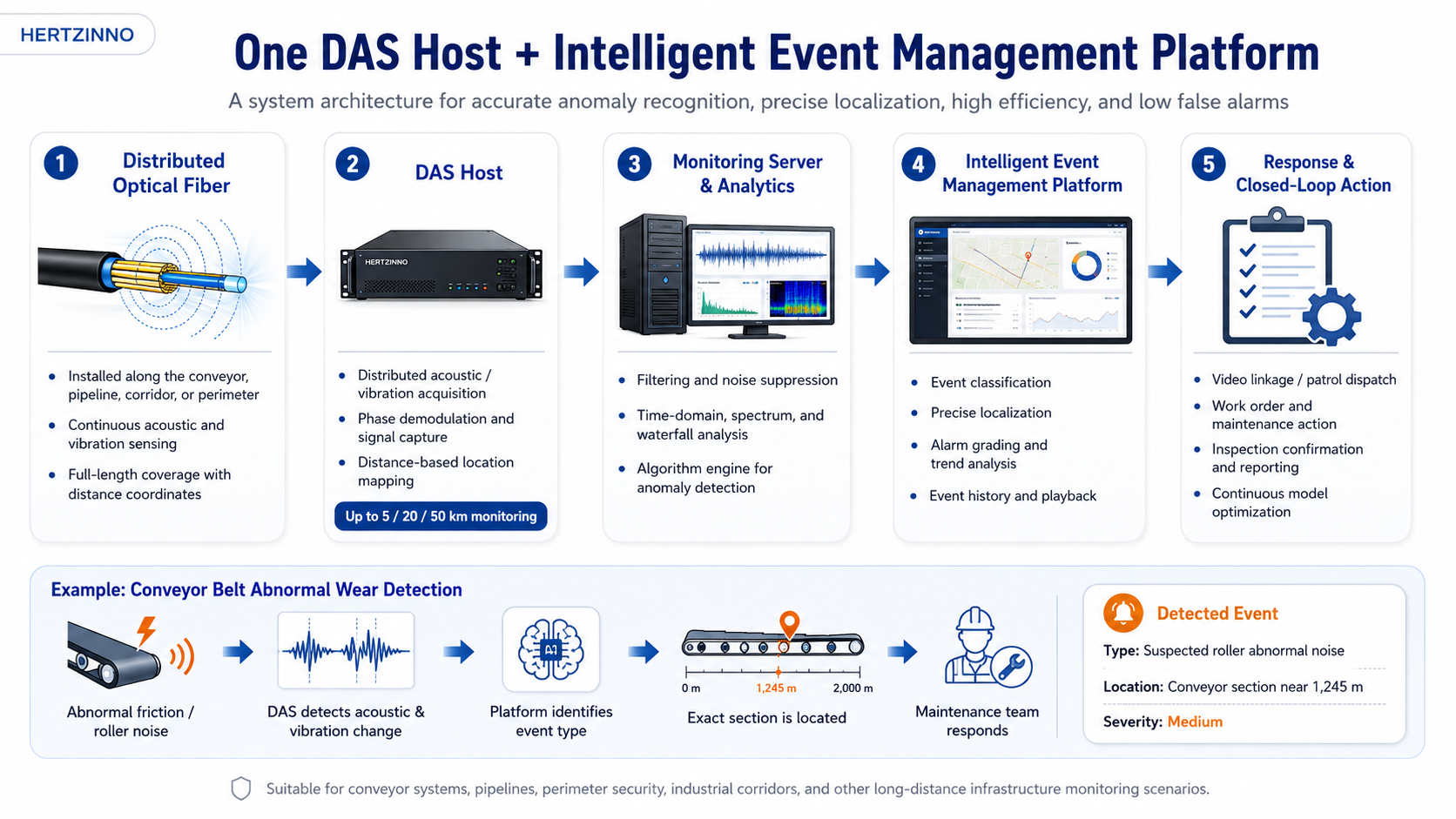
In long-distance conveyor systems, abnormal wear rarely starts as a visible failure. It often begins with small changes in vibration, friction noise, roller sound, or structural impact. By the time the problem is obvious during manual inspection, the conveyor belt, idlers, rollers, bearings, or support structure may already be exposed to higher maintenance risk.
This is why distributed acoustic sensing, or DAS, is becoming a practical technology for conveyor belt monitoring, pipeline route security, perimeter protection, and other long-distance infrastructure applications.
HERTZINNO combines one HZ-iDAS Distributed Acoustic Sensing System with an intelligent event management platform. The goal is not only to collect acoustic and vibration signals, but to convert these signals into clear operational events: what happened, where it happened, how serious it is, and what action should be taken next.
Why Conveyor Belt Abnormal Wear Needs Continuous Monitoring
Conveyor belts are widely used in mining, power plants, ports, cement plants, steel plants, chemical facilities, and bulk material handling sites. These systems often run for long hours and cover long routes. A single abnormal roller, stuck idler, misaligned belt, damaged bearing, or friction point can create a local fault that gradually develops into a larger failure.
Traditional inspection methods depend heavily on manual patrols or point sensors. They can be useful, but they also have limitations:
- Manual inspection cannot continuously cover every section of a long conveyor route.
- Point sensors only monitor selected locations.
- Early abnormal friction or roller noise may be missed.
- Fault location can still require time-consuming field confirmation.
- Environmental noise may cause false alarms if the system only uses simple thresholds.
DAS changes this monitoring approach. Instead of placing thousands of point sensors along the conveyor, a sensing optical fiber is installed along the conveyor gallery, belt corridor, pipeline route, or protected perimeter. The fiber becomes a continuous acoustic and vibration sensing line.
For wider long-distance asset monitoring, see HERTZINNO Fiber Optic Sensing Solutions.
One DAS Host, Full-Route Acoustic and Vibration Awareness
A DAS host sends laser pulses into the optical fiber and analyzes the backscattered signal. When vibration, friction, impact, or acoustic disturbance occurs near the fiber, the system detects the change and maps it to a distance coordinate along the fiber route.
In a conveyor belt application, this means the system can detect abnormal acoustic and vibration activity along the full route, not just at a few fixed points.
The architecture is simple:
This architecture helps operators move from passive inspection to active condition monitoring.
From Raw Signal to Actionable Event
Raw vibration data is not enough for industrial maintenance teams. Operators do not need another complex waveform screen that requires constant manual interpretation. They need a clear event:
The intelligent event management platform plays this role. It processes DAS data through several layers:
- Signal filtering and noise suppression
The platform removes irrelevant background noise and focuses on signal changes that match abnormal vibration or acoustic patterns.
- Time-domain and frequency-domain analysis
Abnormal wear, friction, impact, roller noise, and mechanical disturbance often show different time and frequency characteristics.
- Spatial pattern recognition
A real mechanical issue usually appears repeatedly or continuously at a similar fiber location. Short random disturbances can be filtered out.
- Event classification
The platform classifies events such as suspected roller abnormal noise, conveyor friction, belt misalignment, impact, intrusion, digging activity, or route disturbance.
- Location mapping
The fiber distance is mapped to the conveyor section, pipeline segment, corridor zone, or perimeter area.
- Alarm grading and closed-loop response
Events are assigned a severity level and sent to maintenance teams, patrol workflows, video systems, or operation platforms.
This is the key difference between a DAS sensing device and a complete event management system.
Conveyor Belt Abnormal Wear Detection Workflow
A typical conveyor belt abnormal wear detection workflow works as follows:
For example, if the DAS host detects a repeated abnormal vibration pattern around fiber distance 1,245 m, the platform can map it to a specific conveyor section or idler group. Instead of inspecting the entire conveyor route, the maintenance team can go directly to the suspected section.
This improves inspection efficiency and reduces downtime caused by delayed fault discovery.
How the Platform Helps Reduce False Alarms
False alarms are one of the biggest challenges in industrial monitoring. Conveyor systems, pipelines, and outdoor corridors are noisy environments. Rain, wind, falling material, vehicle movement, footsteps, construction activity, and normal equipment operation can all generate vibration.
A low false alarm system cannot rely only on amplitude thresholds. It needs event-level intelligence.
HERTZINNO’s intelligent event management concept is based on multi-dimensional judgment:
- Does the signal match a known abnormal vibration pattern?
- Does it appear at the same location repeatedly?
- Does the frequency feature match roller noise, friction, impact, or excavation?
- Is the event duration long enough to be meaningful?
- Is it related to a known conveyor operating condition?
- Has a similar event been confirmed or dismissed before?
By combining signal filtering, frequency analysis, spatial consistency, event classification and historical feedback, the platform can reduce false alarms while keeping early warning sensitivity.
For route protection and third-party interference monitoring, HERTZINNO also provides Pipeline & Perimeter Security solutions.
More Than Conveyor Monitoring: Pipeline, Perimeter and Industrial Corridor Applications
The same DAS architecture can be extended beyond conveyor belt monitoring. Because the sensing fiber can cover long routes, it is also suitable for:
- Pipeline route monitoring
- Third-party excavation detection
- Industrial corridor monitoring
- Utility tunnel monitoring
- Perimeter intrusion detection
- Mining gallery monitoring
- Oil and gas field route protection
- Long-distance vibration and acoustic event localization
For oil and gas pipeline security, HERTZINNO’s HZ-PS-20A Smart Pipeline Sentinel can be used for localized third-party interference and excavation monitoring. For gas well and valve leak acoustic monitoring, HZ-WL-15A Gas Well Leak Acoustic Monitor provides edge AI recognition and remote alarm workflows.
For protected areas, border zones, and critical infrastructure perimeters, HERTZINNO also offers Acoustic Defender Security systems.
Why the “One DAS Host + Intelligent Platform” Architecture Matters
A DAS host provides the sensing foundation. The intelligent event management platform turns that sensing data into operational value.
For industrial users, this architecture answers four important questions:
This is especially important for long-distance conveyor belts and remote infrastructure, where manual patrols are expensive and delayed response may lead to equipment damage, production interruption, or safety risk.
The benefits include:
- Full-route acoustic and vibration monitoring
- Faster abnormal wear detection
- Distance-based event localization
- Lower false alarms through multi-feature analysis
- Better maintenance prioritization
- Event history and playback for review
- Scalable deployment for conveyors, pipelines, corridors and perimeters
Building a Smarter Monitoring Layer for Long-Distance Infrastructure
Conveyor systems, pipelines, and industrial corridors are becoming more connected, automated and safety-driven. Maintenance teams need more than isolated alarms. They need intelligent event workflows that combine sensing, analysis, localization, alarm grading and field response.
HERTZINNO’s DAS-based event management architecture is designed for this need. One DAS host provides continuous acoustic and vibration awareness along the fiber route. The intelligent platform identifies abnormal events, locates the affected section, reduces false alarms, and helps teams respond faster.
For projects that require long-distance vibration monitoring, conveyor abnormal wear detection, pipeline route protection or perimeter security, HERTZINNO provides a complete sensing and event management approach.
Explore the HZ-iDAS Distributed Acoustic Sensing System or visit HERTZINNO Fiber Optic Sensing Solutions to learn how DAS can be integrated into your monitoring workflow.
For oil and gas safety applications, you can also review HERTZINNO’s Methane Leak Detection Solution.